
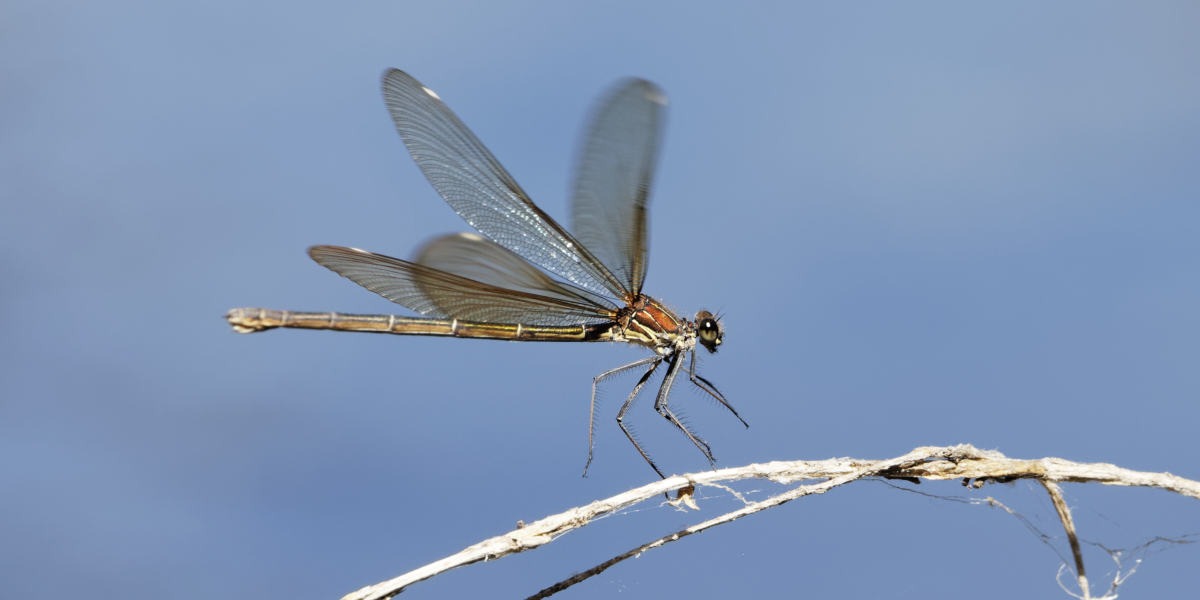
Dragonfly photography – how to catch them in flight
Dragonflies have long fascinated me as photographic subjects. I admire their beautiful colors, their bizarre body structure, and their flying skills. My absolute favorites in dragonfly photography are the demoiselles (family Calopterygidae). In Sardinia, I often see them along small rivers and streams, perched, in action, interacting, and in flight.
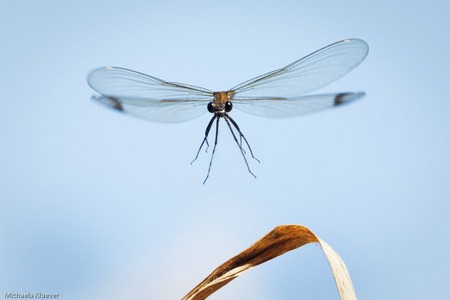
For over a year, I’ve been studying their behavior – with and without a camera. This has resulted in a beautiful collection of portraits and behavioral studies. (You can find more about this in the archive under ” The Little Blue Men” and ” Black and White Dragonfly Photography.”) However, two image ideas were still missing for me at the end of last year’s dragonfly season: flight shots of individual dragonflies and their interactions in flight. Figuring out the best way to achieve this was my goal for this year’s dragonfly photography season. For me, the first step in animal photography is always observing species-typical behavior, combined with research in literature and online.
Here’s the basic information – observation and research
The species I observed is the Bronze Demoiselle (Calopteryx haemorrhoidalis) . Its distribution is limited to the western Mediterranean region. Its total length is 45 to 48 millimeters, and its wingspan is approximately 45 to 70 millimeters. As the name suggests, the females are bronze-colored, while the males are blue. However, the perceived color varies depending on the viewing angle, ranging from almost black to transparent in males and from dark brown and golden to transparent in females. An interesting detail is the so-called ” red lantern” on the underside of the last two abdominal segments in males; this feature is the origin of the species’ scientific name, haemorrhoidalis .
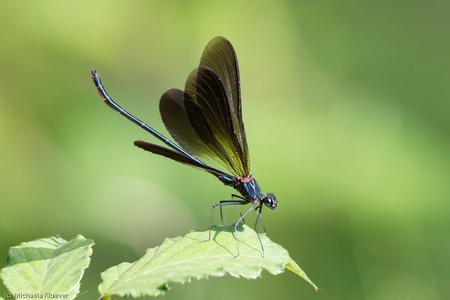
a male displays the red lantern.
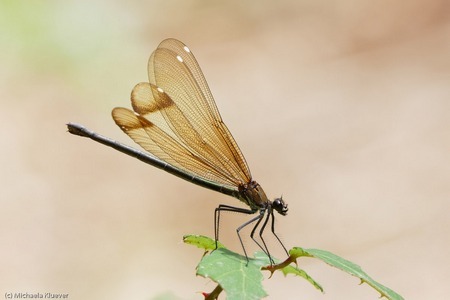
Dragonflies follow a fixed daily rhythm. In July and August, the time between 9 and 10 a.m. is well-suited for photographing their flight. After warming up in the sun, the insects hunt from perches to which they repeatedly return. They often orient themselves at approximately 90° to the sun (when it is shining). In the characteristic sequence of perching – takeoff – catching prey – return flight – perching + feeding , the perching + feeding phase is ideal for portrait studies. The two photos above this paragraph show two examples. Often, there are only 1-3 minutes until the next hunting flight. This is enough time to position the camera at eye level, parallel to the insect’s body axis, and focus on the eye and thorax area. To avoid disturbing or scaring the insects away, I use the Canon EF 100-400mm lens at 400mm with an extension tube instead of the 180mm macro lens. This arrangement allows me to maintain a slightly greater distance from the subject, and the dragonfly continues hunting quite unimpressed despite my presence.
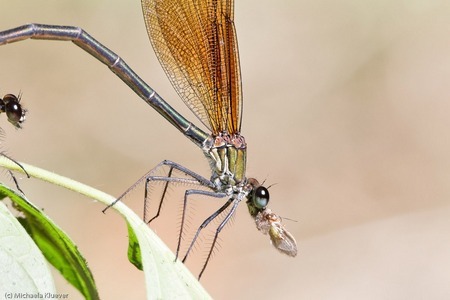
Ready for aerial photography
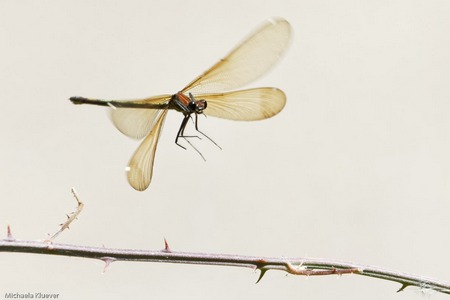
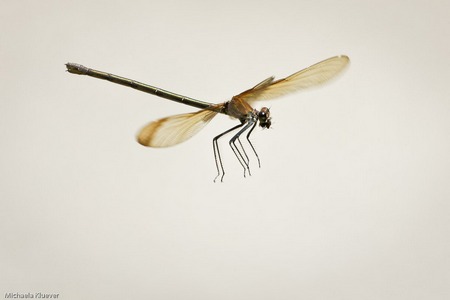
The dragonfly remains perched until its prey is swallowed. This phase is easily recognizable in the viewfinder by the feeding movements of its mouthparts. I’ve never managed to photograph the subsequent takeoff; it simply happens too quickly. However, the return flight and landing scenes are easier to follow visually. This is the moment when the chances for flight shots are favorable. To prepare, the camera is positioned at eye level, parallel to the insect’s body axis, as described above for portrait studies. In live view, I focus on the eye and thorax area. Then I switch to manual focus and, with the camera set to continuous shooting, wait for the landing approach. My eye isn’t looking through the eyepiece, but rather following the dragonfly. It’s important to leave some space in the frame and ensure a calm, gently blurred background.
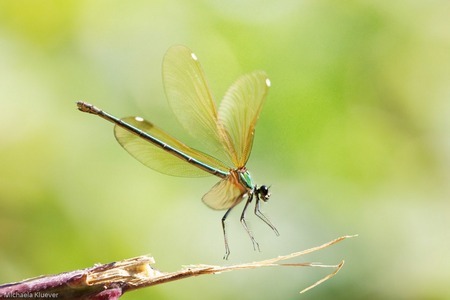
At first, I received many photos of empty perches. I also frequently got fantastic, sharp images of dragonflies, but unfortunately, only half of them were visible in the frame. However, over time, by observing their typical approach paths, I was able to anticipate the sequence of events better. My shutter pressure became more precise, and the number of unusable shots decreased. I frame my shots so that there’s still a dragonfly’s length of space behind the perched insect. This increases the chance of capturing the entire insect in flight, without anything being cut off, when it lands from this direction. If necessary, I crop the image slightly later.
Harassment
Wind – A sturdy branch as a perch makes the landing more predictable than a thin blade of grass that sways back and forth with every slight breeze. Sharp photos are therefore more likely to be successful if I concentrate on the animals perched on stable vantage points. Often, the dragonfly lands exactly at the point on the branch from which it took off. In that case, the available depth of field at f/11 also covers a portion of the approach path.
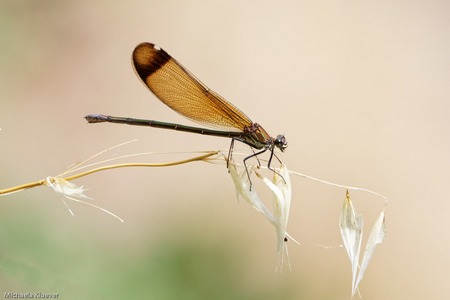
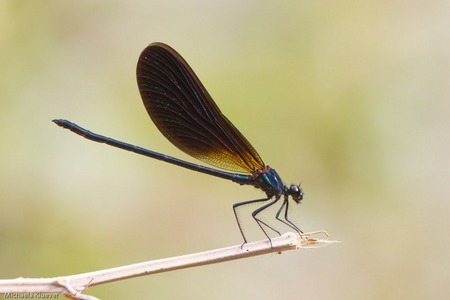
Image composition
Ultimately, the conscious composition of the background is crucial when deciding whether to delete or keep a photo. If it’s too busy, I delete the photo. Since, on the other hand, the depth of field in dragonfly photography should cover at least the eye and thorax area, I’m on the safe side with f/11. Depending on the angle of entry, f/8 sometimes works, and f/5.6 becomes difficult, but not impossible; image 13 in the gallery below is an example. This makes creating a calm background challenging. This only works if the distance between the camera and the dragonfly is significantly less than the distance between the dragonfly and the first background elements. As a test, I take a photo of the dragonfly at rest before taking the flight shots, check the result on the camera monitor, and adjust the tripod position slightly if necessary.
Aside from the background, I prefer the photos that include the intended landing spot in addition to the flying dragonfly. I think that creates a connection to the surroundings and makes the image more vibrant.
Fascination of dragonfly flight
When discussing the flight skills of dragonflies, the helicopter comparison often comes up. This means that both helicopters and dragonflies can hover over an object. But dragonflies can do much more. Their four wings are individually adjustable. They are controlled by muscles located on the thorax. The red “decorations” in the photo are the attachment points. Each individual wing is connected to its corresponding muscle at these points. This is why photos of flying dragonflies are so varied. You can get an idea of this by looking at the photos in the gallery below.
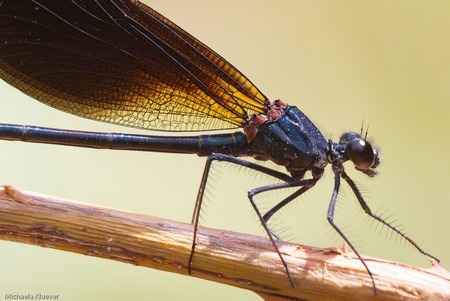
Is this still flying or is it already landing?
The transition between flight and landing is fluid. I’ve decided to consider photos as flight shots when at least four legs are still in the air. The landing phase, when four to six legs are already touching the landing platform, also makes for very beautiful, dynamic photos, which I often like even better than the flight shots. If the goal is to show a sequence of the flight-landing process, these should definitely be included as well.
To conclude, here’s a gallery of my photos of dragonflies in flight this year. Photo number 9 shows the next level of difficulty: interaction in flight. But that’s a topic for another time. I like numbers 1 and 13 best because of the soft, multicolored background. And which are your favorites?
Click on a preview Image for fullscreen View
See comments >