
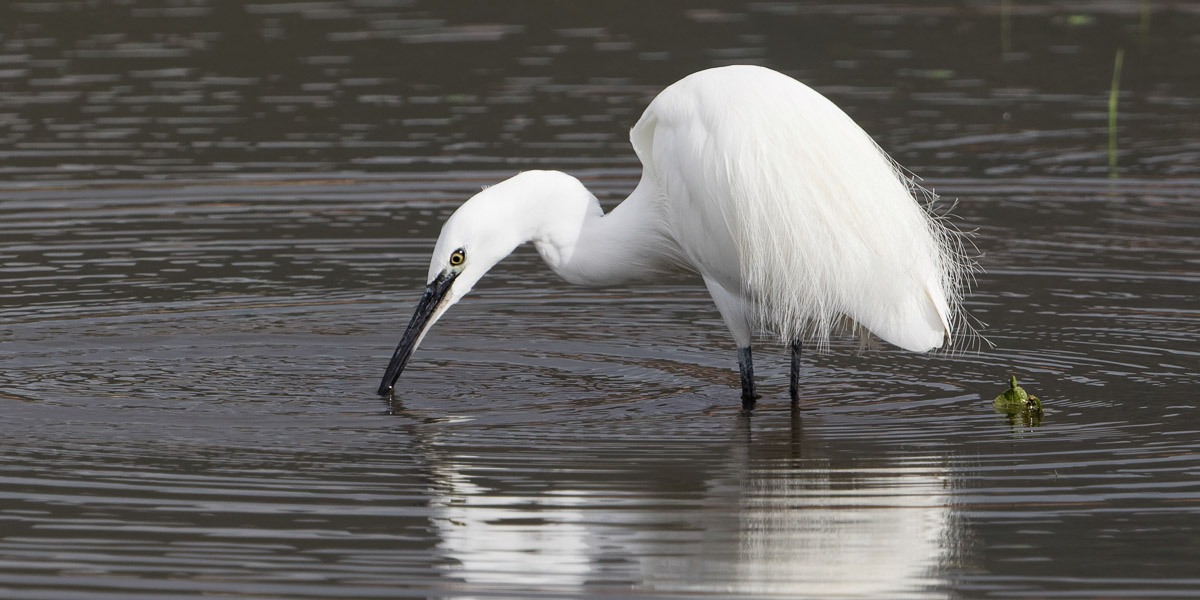
Little egrets in Sardinia
White herons have long captivated me as photographic subjects. They aren’t particularly rare, nor do they boast striking colors; it’s their understated elegance that appeals to me. In Sardinia, depending on the migrating season, you can observe cattle egrets (Bubulcus ibis), little egrets (Egretta garzetta), and great egrets (Egretta alb ). The smallest of the white herons, with a body length of 46 to 56 centimeters, are the cattle egrets. They are often seen in groups accompanying flocks of sheep or cattle, and occasionally they can even be seen riding on the backs of grazing animals.
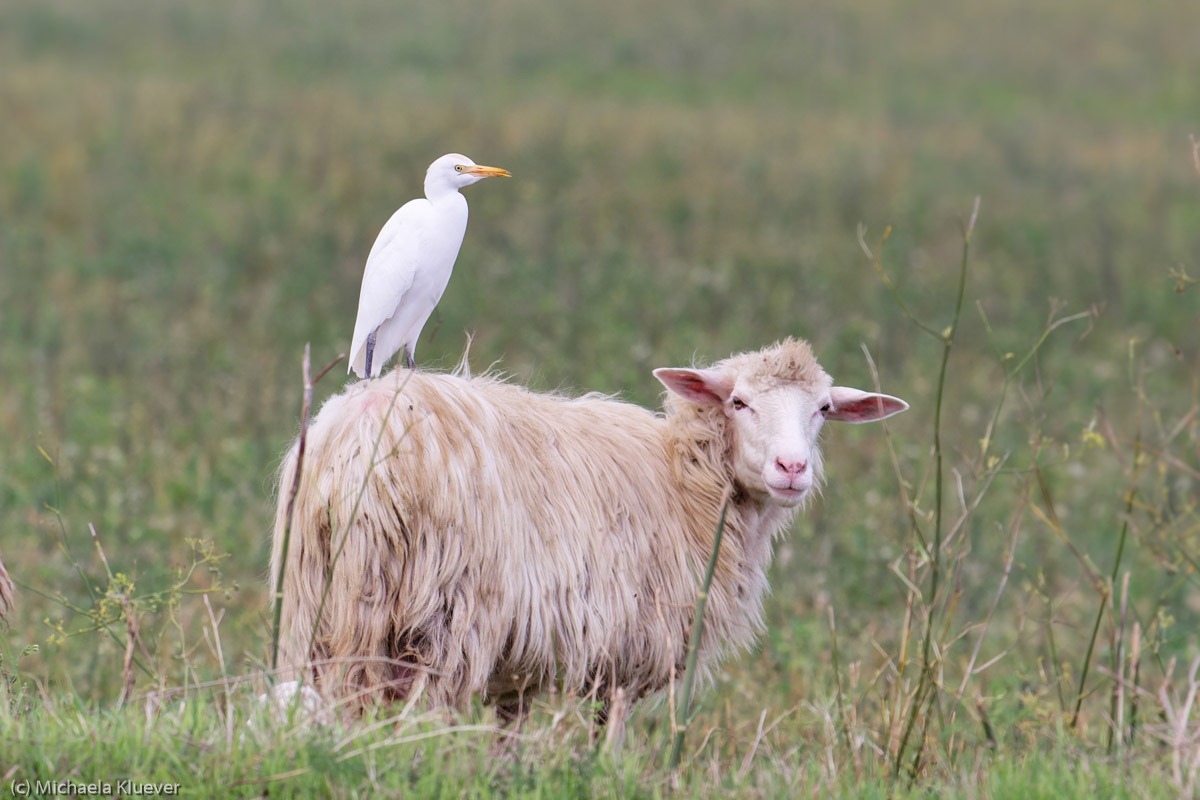
Cattle egrets
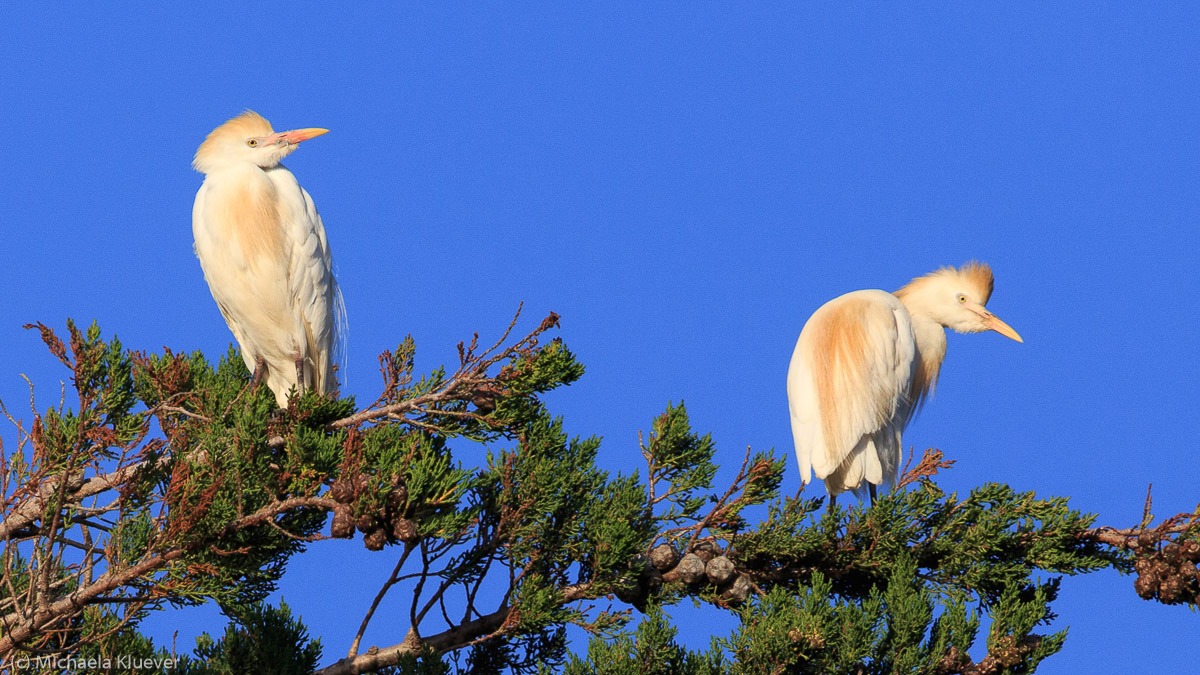
Cattle egrets are particularly attractive during the mating season, when they display rust-colored ornamental feathers on their head, breast, and neck. The photo shown here was taken in March.
Little egret
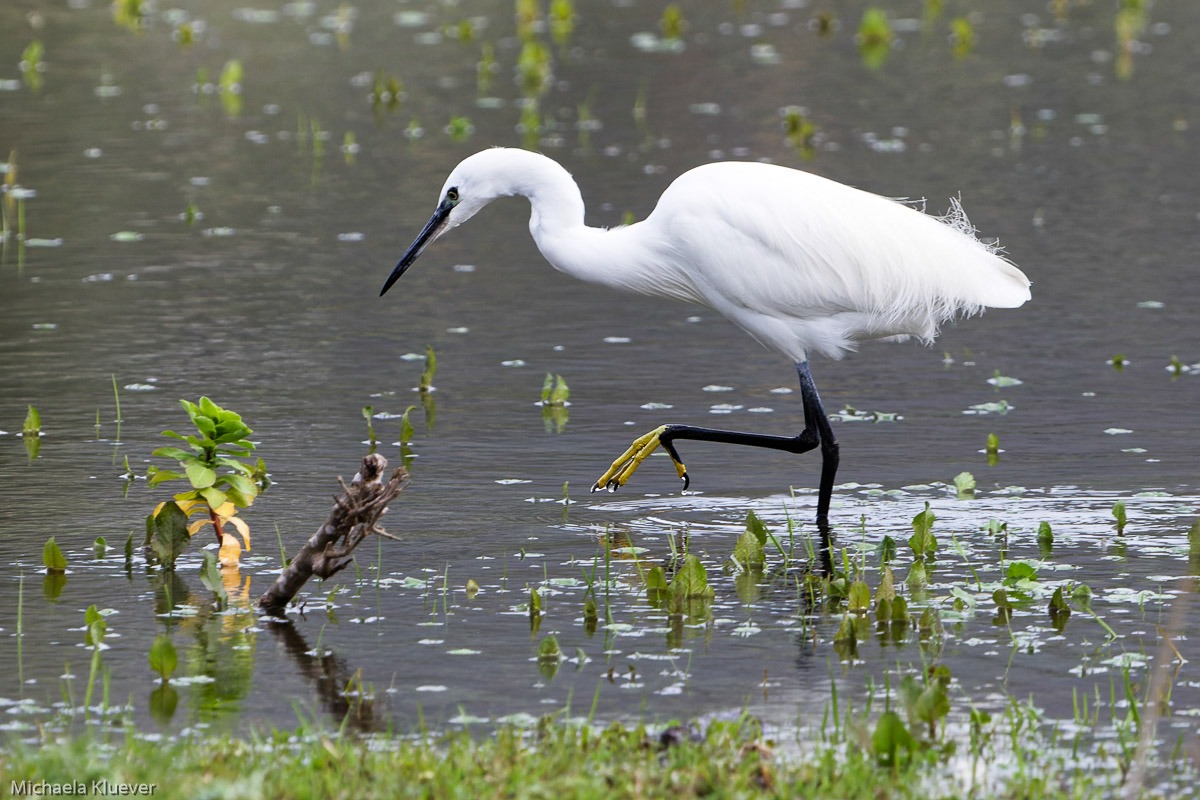
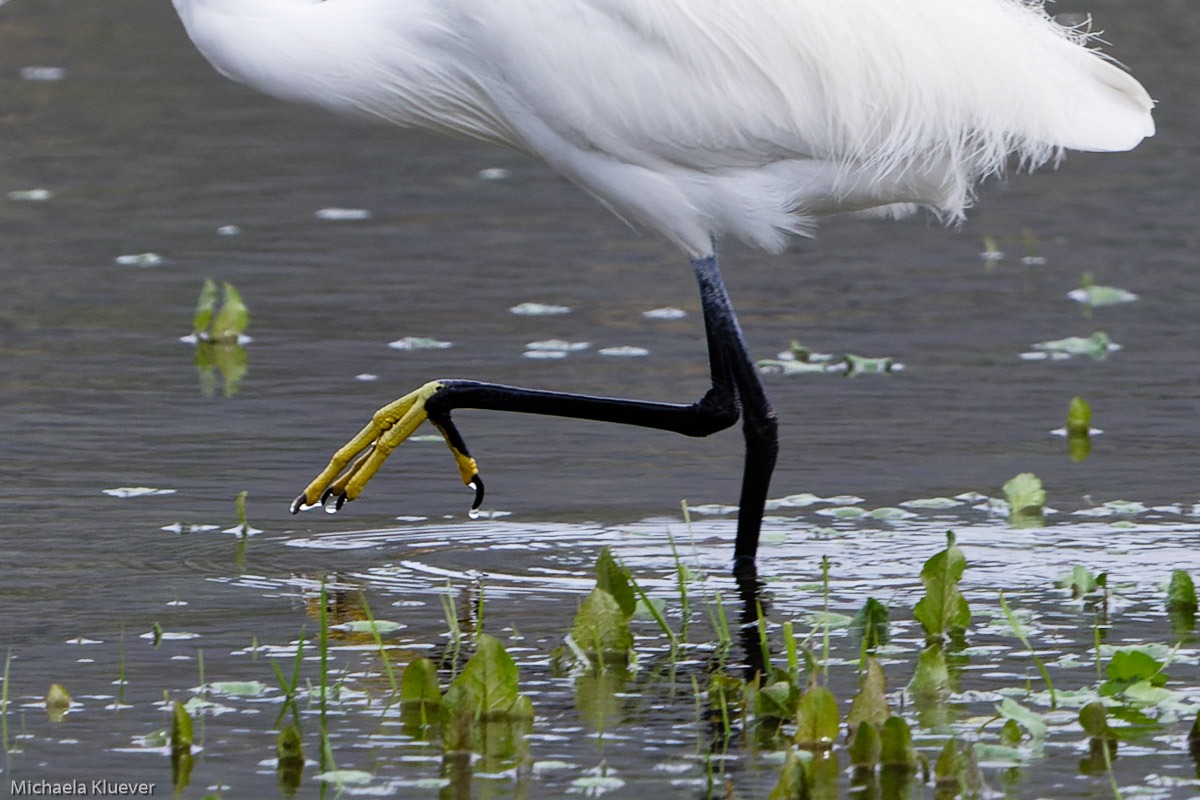
Much larger than cattle egrets, great egrets reach a body length of 85 to 100 centimeters. Little egrets, at 55 to 65 centimeters, fall between these two in size. With their completely white plumage, little egrets resemble great egrets from a distance, but their smaller size makes them easily distinguishable upon closer inspection. Their beaks and legs are black, and their feet are yellow, which is another distinguishing feature from the great egret.
Photography tip: When taking photos that isolate the animal from its surroundings with a long focal length, the size is often no longer legible on the PC later. To remedy this, it is helpful to include a photo showing the yellow feet in a series of shots. A simple, documentary-style photo without any artistic ambitions is sufficient; as long as the yellow feet are somewhat sharp. Then, when you review the images even months later, the species will be well documented. The two photos below this paragraph show such a documentary photo and a foot in an enlarged detail on the right.
Understated elegance
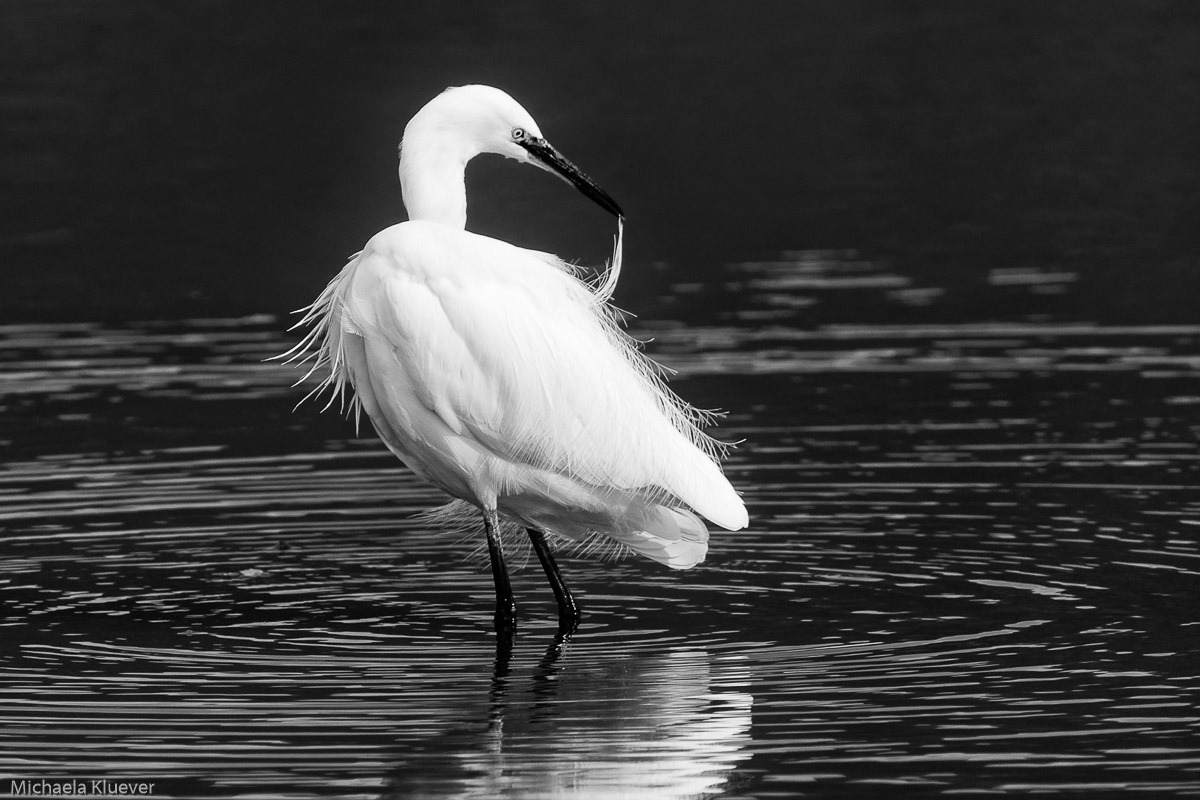
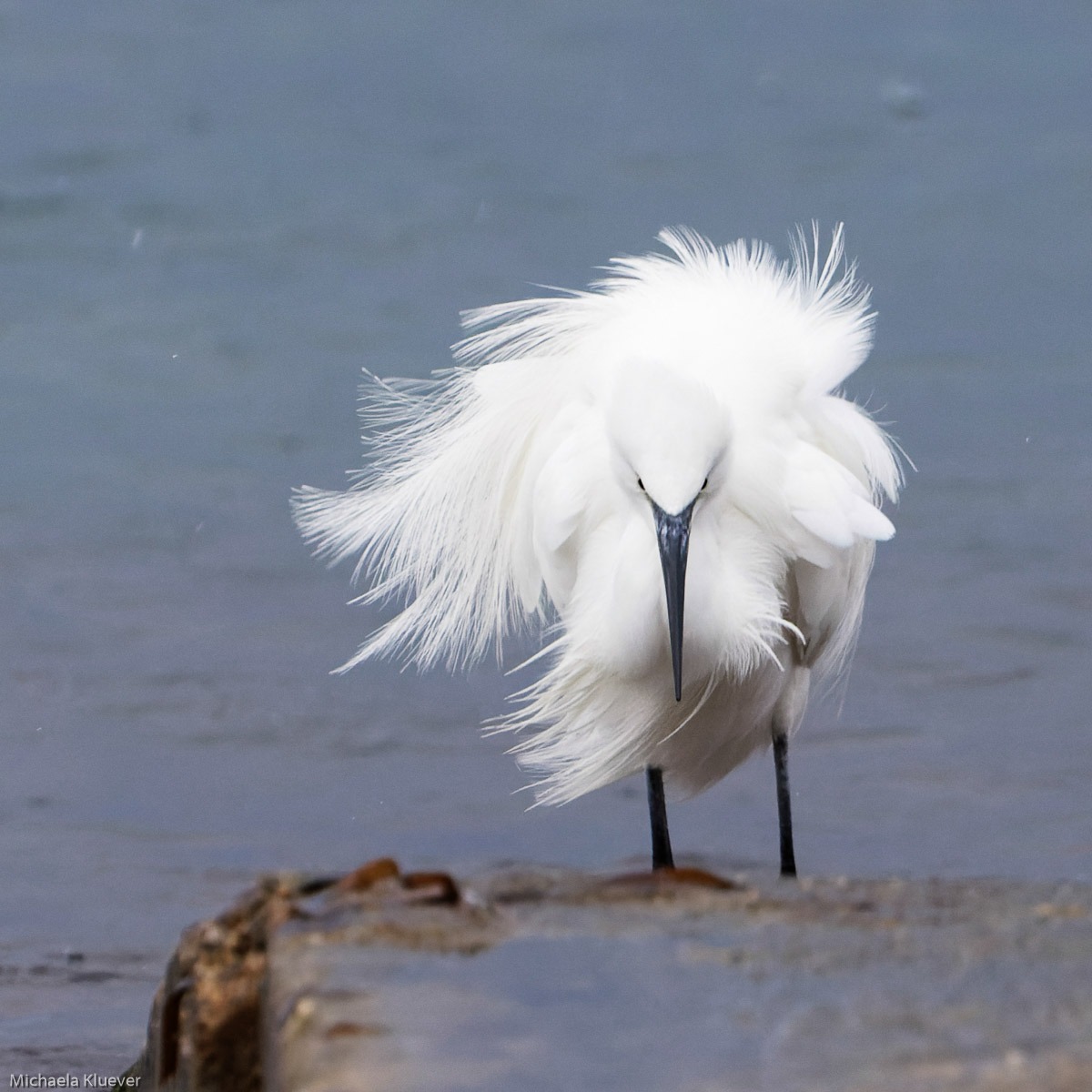
Little egrets, with their delicate build, appear very elegant. When their fine feathers stand out slightly from their bodies in a light breeze or during preening, it reminds me of delicate lace doilies or spiderweb designs. These are the moments for photos that show the subtle elegance of the animals. In these cases, I also like black and white processing very much, the image on the right shows an example.
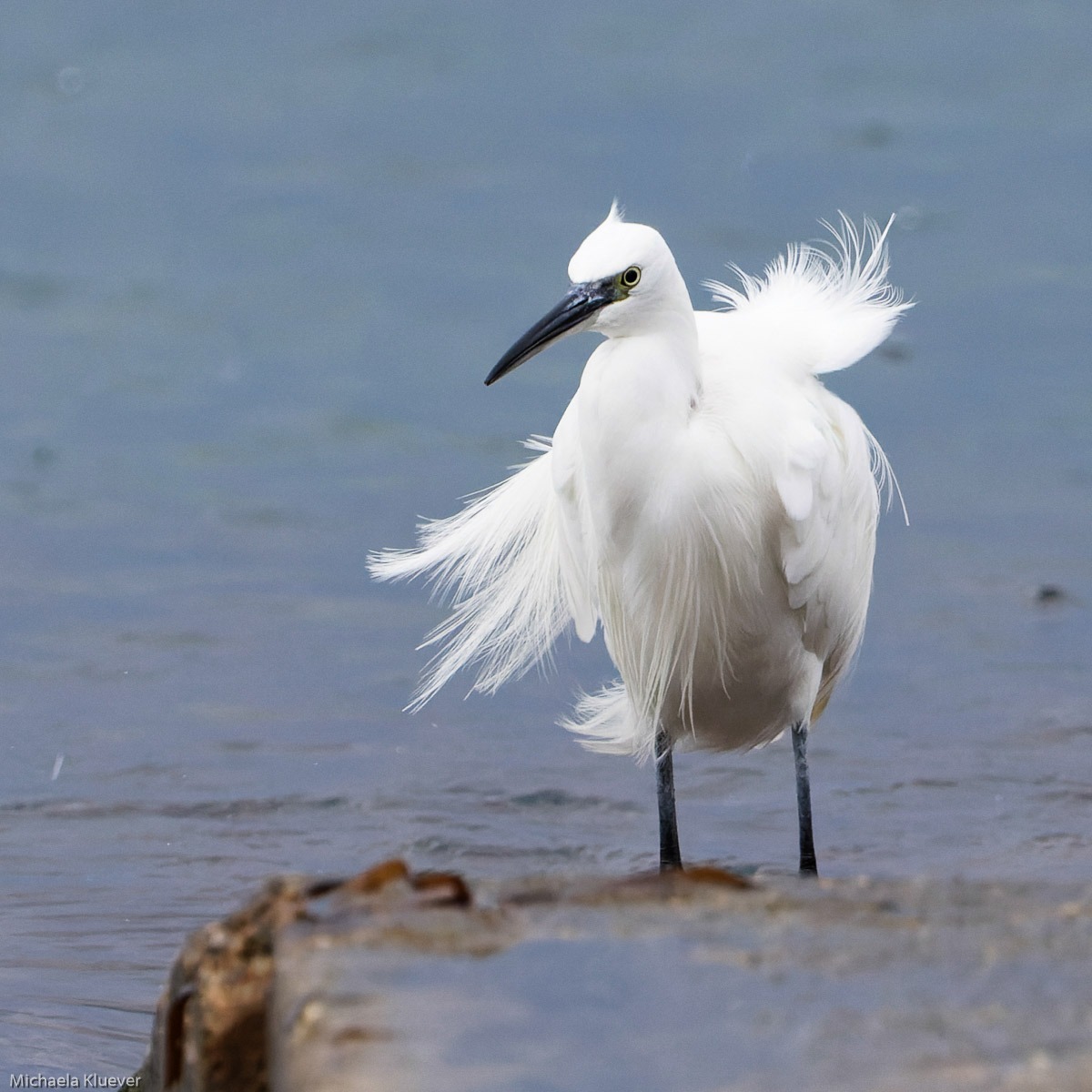
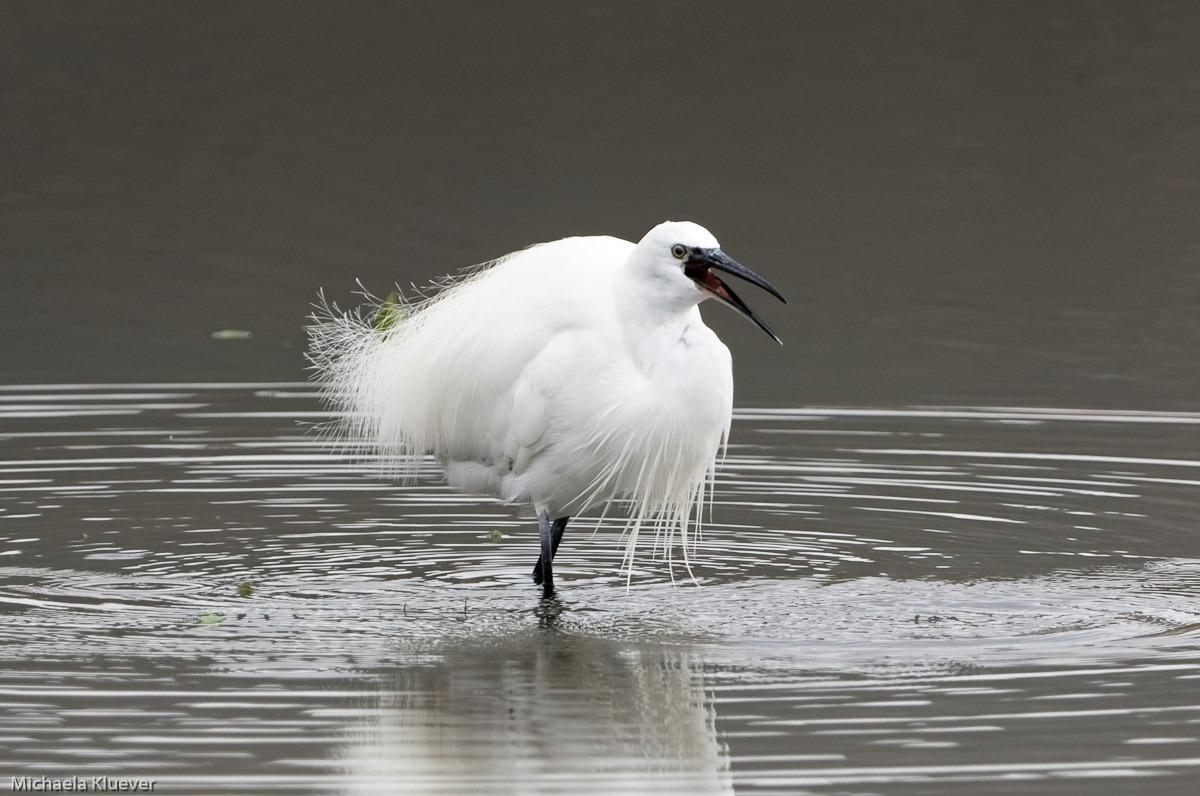
Things get especially exciting when the animals use their feathers as a means of “body language”. With its puffed-up plumage, the bird appears larger. This can be seen as a threat. The two photos taken in quick succession below this paragraph illustrate this. I was so far away with a 400mm focal length that the animal didn’t feel disturbed. But when, in imitation of my photo activity, a person got closer with their smartphone, he first made himself bigger to signal “you there, with your phone, get lost”. When that didn’t work, it flew away.
Camera settings
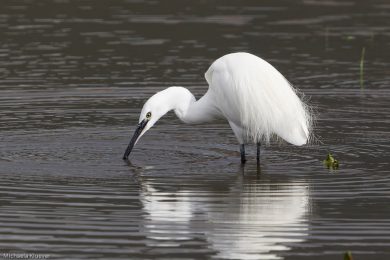
White plumage can be challenging in terms of exposure. I avoid bright sunlight and midday because the white tones of the feathers become washed out and lack detail. A slight negative exposure correction can compensate for this. Light cirrus clouds in the sky create more diffused light on the scene. This is better suited to rendering the fine feather details in the image as subtle gradations of white. But interesting photos can also be taken under completely overcast skies and even in the very soft light of a rainy day. The two photos above this paragraph were taken in the rain. The photo under this paragraph, on the other hand, was taken with a slightly hazy sky. The animal signals an intruder in the feeding grounds that they should keep their distance. Here, too, exposure correction can be useful, in this case, a positive correction. As always, checking the histogram is helpful when in doubt.
Where can I find little egrets?
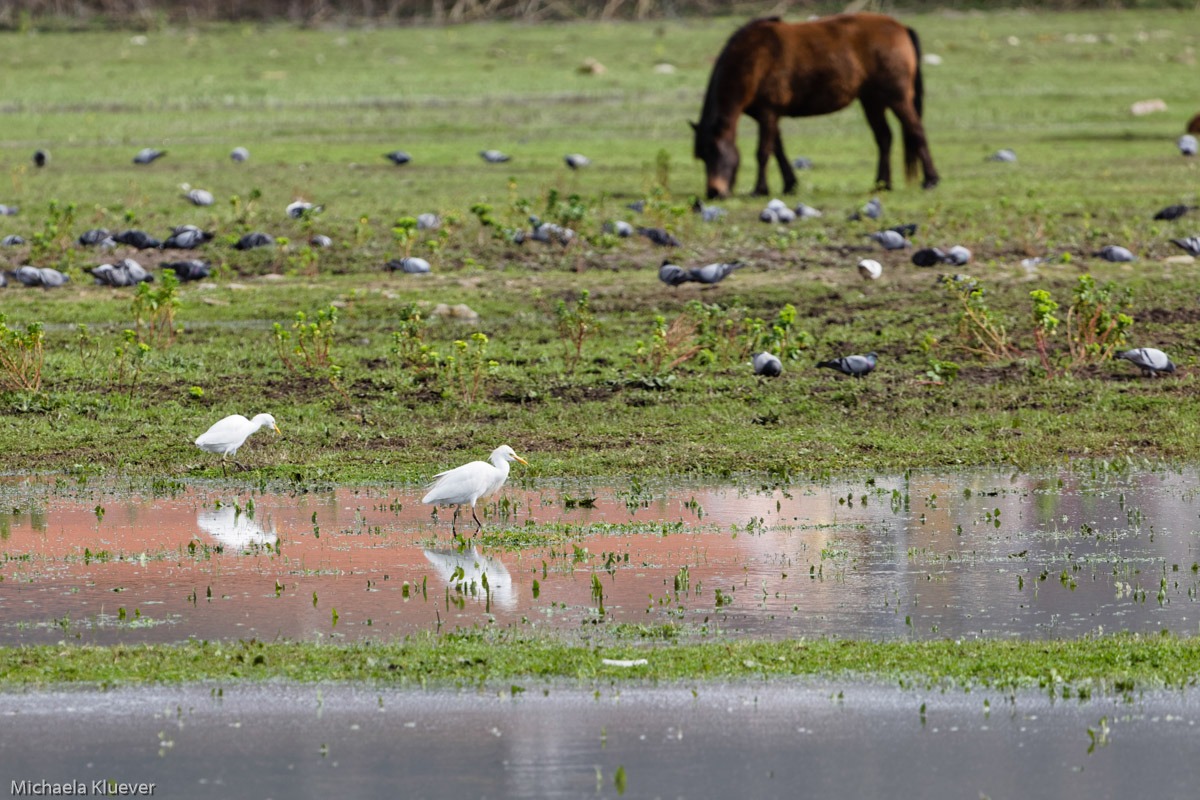
Little egrets like to frequent small ponds and also prefer floodplains. After the heavy rains in January and February of this year, I was able to observe them together with cattle egrets in a pasture that had temporarily become a lake.
What do little egrets eat?
According to Wikipedia, little egrets eat small fish, frogs, lizards, worms, mollusks, and aquatic insects. The next photo shows a little egret struggling with a frighteningly large earthworm.
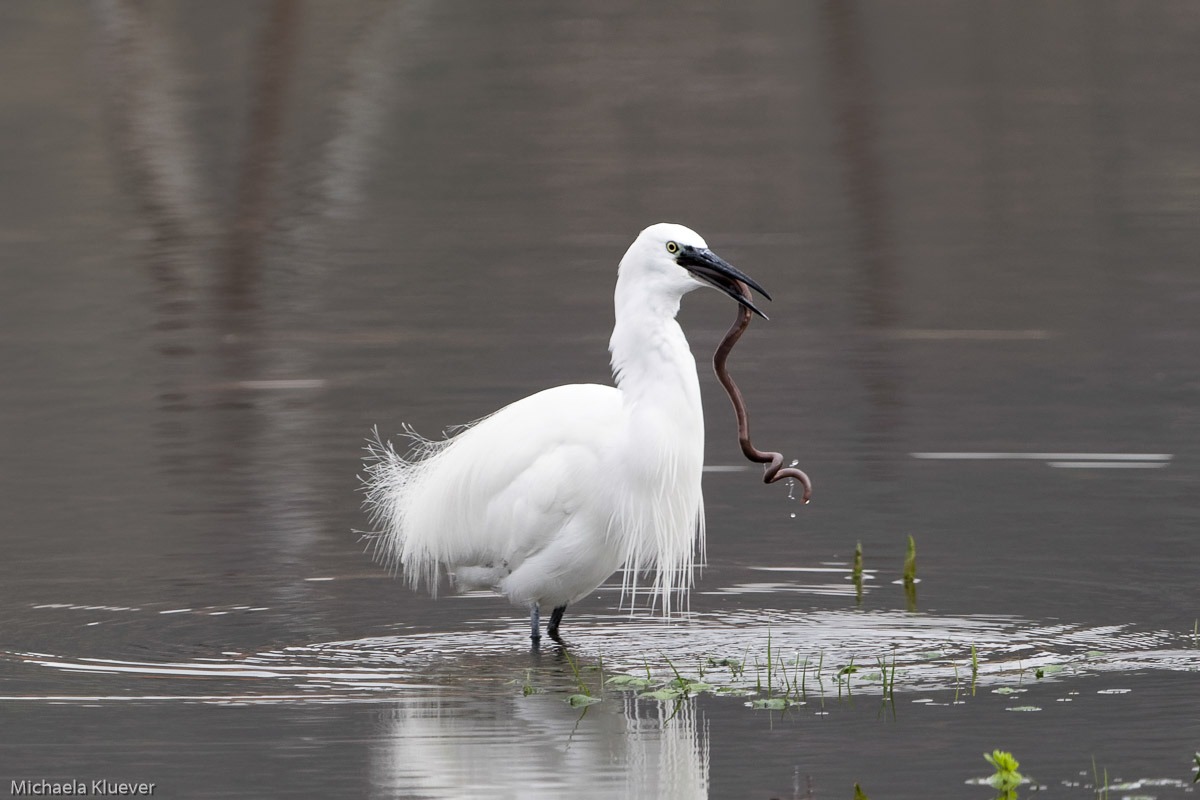
In my opinion, the fight with the giant earthworm is better shown in a sequence than in a single photo. The heron-earthworm scene went on for quite a while. The bird was clearly struggling with its prey. This gave me the opportunity to take a whole series of shots, which I later sorted and combined some into the sequence shown below. To ensure the sequence blends harmoniously, all photos are aligned with the water surface level. For displaying a single image, this isn’t necessarily the best choice of composition; in some cases, it’s better to than optimize the framing slightly differently.
Here is the heron-earthworm sequence. I like this type of presentation better than the single image above because it is easier to see the effort the heron put into catching the earthworm. What do you think?
Read/write Comments >>