
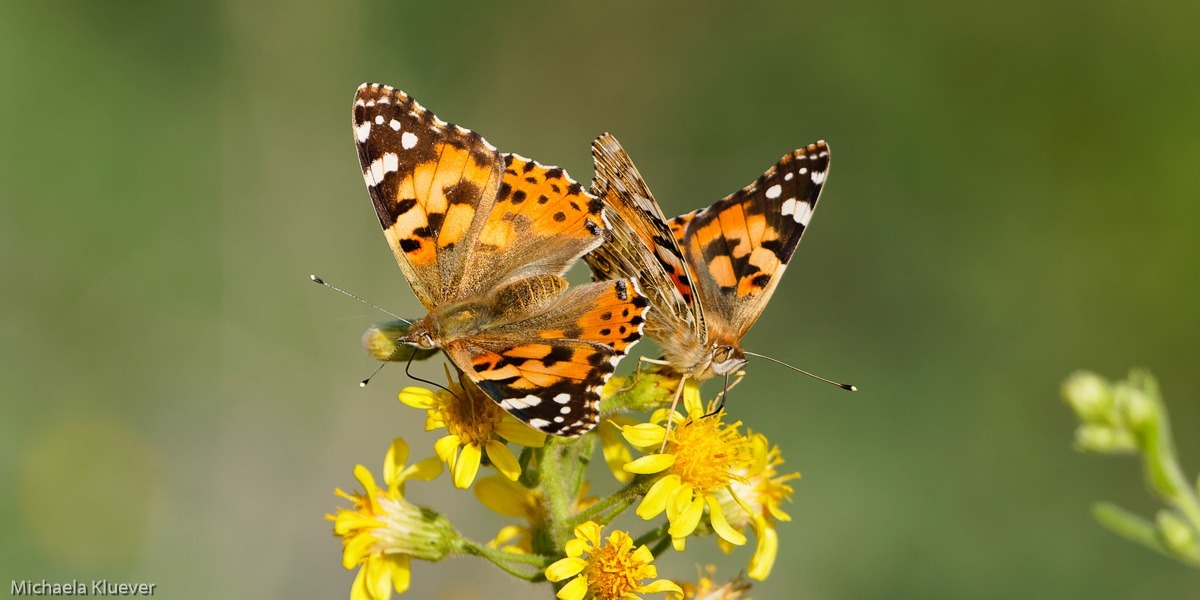
Migratory butterflies – butterflies that travel 4000 kilometers
The most well-known example of a migratory butterfly is the American monarch butterfly (Danaus plexippus). The mass migrations of these animals are among the most intensely studied phenomena in the field of animal navigation. In autumn, they fly 3,500 kilometers from North America to their wintering grounds in Mexico. There, they gather in a mountainous, forested region, where they overwinter hanging from tree branches. In spring, they begin their return flight, but their destination is not reached until the next generation of butterflies. In December 2015, I was delighted to be able to take photos of these navigational experts on the Mexican Pacific coast.
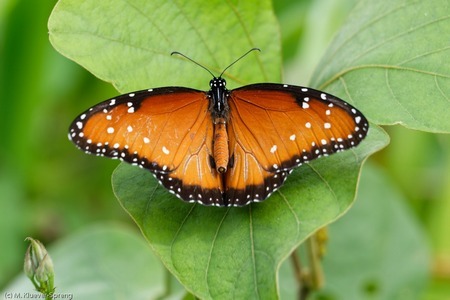
Current state of research on migratory butterflies
Even some of the butterflies that appear in Europe in summer have undertaken long migrations. (If you’re interested in how many and which species these are, you can find a list of migratory butterfly species on the Butterfly and Caterpillar Portal .) Last year, I read more about the current state of research on migratory butterflies in the book *The Untold Story of the Animal’s Journey* by David Barrie (London 2019, German translation by Malik Verlag 2022). It states that, in terms of the distances traveled, painted lady butterflies can certainly rival monarch butterflies: “Millions of these insects leave North Africa in spring, and after several generations, their offspring finally reach Northern Europe, where they breed in large numbers. Their young then migrate south again to escape the Northern Hemisphere winter. This journey is almost as long as that of the monarch butterfly.”
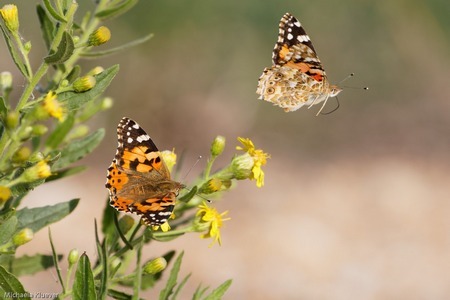
Migratory butterflies in Sardinia
In November 2024, I was able to observe and photograph a swarm of migrating Painted Lady butterflies on the west coast of Sardinia. A fascinating experience and a real nudge for further research on migratory butterflies. Initially, the information I gathered was occasionally contradictory. In this case, checking the publication date of the sources used is helpful. In recent decades, climate change has altered the migratory behavior of some species. New research findings have also emerged, leading to a better understanding of some phenomena. I have compiled a few results of my research here for the two migratory butterfly species, the Red Admiral and the Painted Lady. You can find more butterfly species in Sardinia in my gallery ” Butterflies in Sardinia” .
admiral
The Red Admiral ( Vanessa atalanta ) is present in North Africa, Europe, and as far as Asia. Older publications describe the Red Admiral as a long-distance migratory butterfly, capable of covering the 2,000-3,000 kilometer journey from North Africa to Central Europe in two weeks. However, this is no longer accurate due to the existence of an independent Central European population, as reported, for example, by NABU, which maintains a reporting portal on naturgucker.de . There are now regional Central European populations that migrate north from their respective areas in spring. Two to three generations later, their offspring migrate south again in autumn. There, they mate in late autumn/early winter. The new generation then migrates north again in spring before mating.
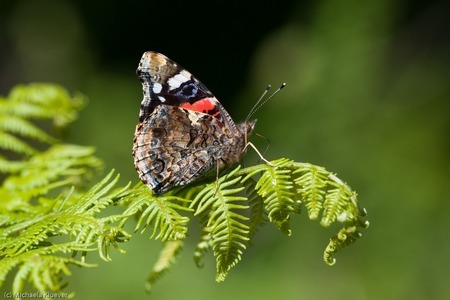
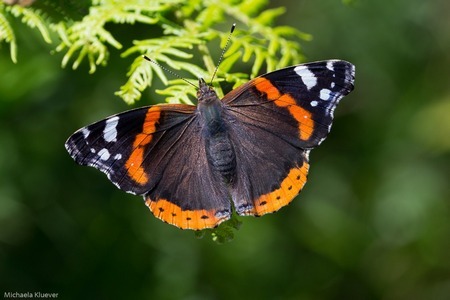
This seasonal migration allows them to use new habitats as feeding and breeding grounds that are not permanently habitable for them. The female butterflies seek out nettles (the caterpillar’s food plant) to lay their eggs. The caterpillar spins a nest in the leaves. These characteristic, spun-together leaf pouches can occasionally be seen while walking along the roadside. Central European populations have been reported to migrate as far as southern Scandinavia in spring and back to southwestern Germany in autumn.
Painted Lady butterfly
Like the Red Admiral, the Painted Lady butterfly is a multi-generational migrant. In February 2025, GEO.de dedicated an article to this butterfly entitled “4,000 Kilometers in One Go: The Record Migration of the Painted Lady.” The article explains that the southward migration, from Northern Europe to Africa, is a non-stop flight, while the opposite direction, from Africa across Southern and Central Europe back to Northern Europe, is covered in generational stages. Each generation completes only a portion of the journey. In late winter, the first northward leg begins, from Africa across the Mediterranean. This is followed by egg-laying in Southern Europe. The caterpillars, often found on thistles and nettles, spin leaves into a protected hiding place, similar to the Red Admiral. From March onward, the next generation emerges there, some of which continue on to Central Europe. After another two to three summer generations, the offspring, as the weather begins to colden, fly south without stopping. Swarms of millions of painted lady butterflies were observed in 2003, 2009, and 2019 (see naturgucker.de ). Alpine passes, serving as flight corridors, were said to be excellent observation points.
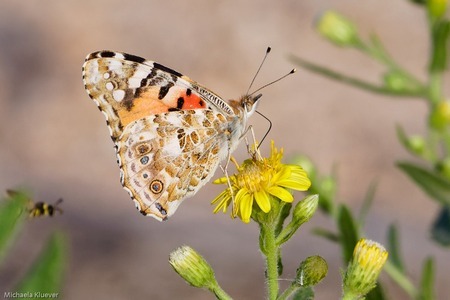
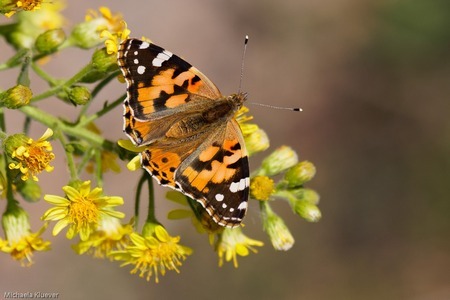
Migratory butterflies like the Red Admiral or Painted Lady are said to be able to beat their wings about ten times per second. This allows these tiny creatures, weighing only a few grams or tenths of a gram, to reach speeds of 7-15 km/h – and even more with a tailwind. Even the slower migratory birds are significantly faster (>=40 km/h). However, these are surpassed by hawk moths. With a wingbeat frequency of 70 times per second, they reach a flight speed of 50 km/h. The Hummingbird Hawk-moth even reaches 60 km/h and more. Migratory butterflies don’t achieve their high speeds solely through their wingbeats, though. They also use strong winds to carry them. Observations of more than 1,000 Red Admirals in September on their journey south from Finland showed that almost all of them used the northerly wind to assist their flight. If the wind shifted, they stayed on the ground. How do the butterflies know this?
Different flight routes
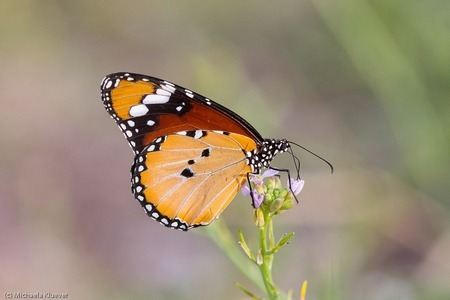
When I began to delve deeper into the subject, I also learned that the butterflies migrating from Africa use different flight paths: one leads over Gibraltar, Spain, and France, another over Sardinia, Corsica, and the Alps, and yet another over Turkey and the Balkans. So, I live in a butterfly flight path. Wonderful! However, that doesn’t mean swarms of butterflies appear here every few days in autumn. It’s more like the autumn starling flocks: sometimes you’re lucky and see the most spectacular flock of starlings ever for a few hours. In the following years, you look expectantly to the sky again at the same time, but the birds are swarming somewhere else. I encountered a group of African monarch butterflies in Sardinia 12 years ago. Since then, I’ve seen individual butterflies flying every year, but I’ve never again been lucky enough to encounter a whole group.
How do animals navigate?
How do butterflies know where to fly? And how do they find their way? Why do some fly over Gibraltar, others over the Balkans? Exactly how this fascinating long-distance navigation works in butterflies, and on which sensory perceptions it is based, is far less understood than in migratory birds. How each generation of butterflies manages its flight navigation is not fully understood. A genetic component is suspected, combined with the ability to navigate by the position of the sun (time-compensated solar compass) and to utilize wind currents. Traces of the long journey are frayed and broken wing edges. Occasionally, they also appear somewhat faded. Butterflies that look so “worn out” may have already traveled many kilometers, while those that have just hatched locally are unharmed and have fresh colors.
Much remains unexplored.
In his aforementioned book, David Barrie reports on several studies on this topic. For example, he discusses Professor Henrik Mouritsen from the University of Oldenburg, who, together with B. Frost, investigated the influence of various factors on flight behavior under controlled conditions and confirmed that butterflies, like migratory birds, possess a time-compensated solar compass. To navigate in the correct direction, butterflies must have direct sunlight; they become disoriented under overcast skies. Whether the angle of the sun above the horizon, the light intensity, or the spectrum of sunlight are the crucial signals is still unknown. There are several hundred species of migratory butterflies, the majority of which are moths. However, navigation based on the sun’s position doesn’t work at night. How do moths orient themselves? According to Mouritsen, it cannot be ruled out that migrating moths—like birds migrating at night—use the Earth’s magnetic field for navigation. It’s a fascinating field of research with much still to unravel and discover!
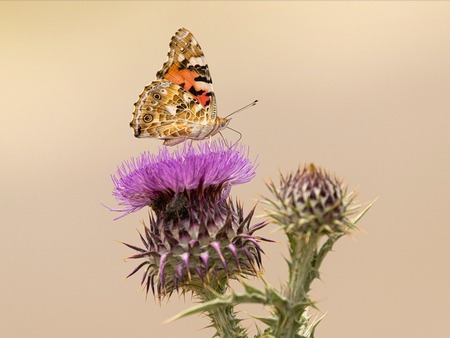
Perhaps you’ve caught the bug and are now also looking for traveling painted lady butterflies? It’s possible that those arriving at your location recently made a stopover here in Sardinia. Peter Liebthal’s photo directly above this paragraph makes it possible to trace a path from Sardinia to Germany, symbolically illustrating the long journey these creatures are capable of. Thank you, Peter, for your beautiful butterfly on a thistle blossom! Of course, we don’t know where this painted lady came from or where it was headed. Just let your imagination run wild!
See comments >